

op@clsu.edu.ph (044) 940 8785
CLSU Logo

Central Luzon State University

Science City of Muñoz, 3120 Nueva Ecija, Philippines

University

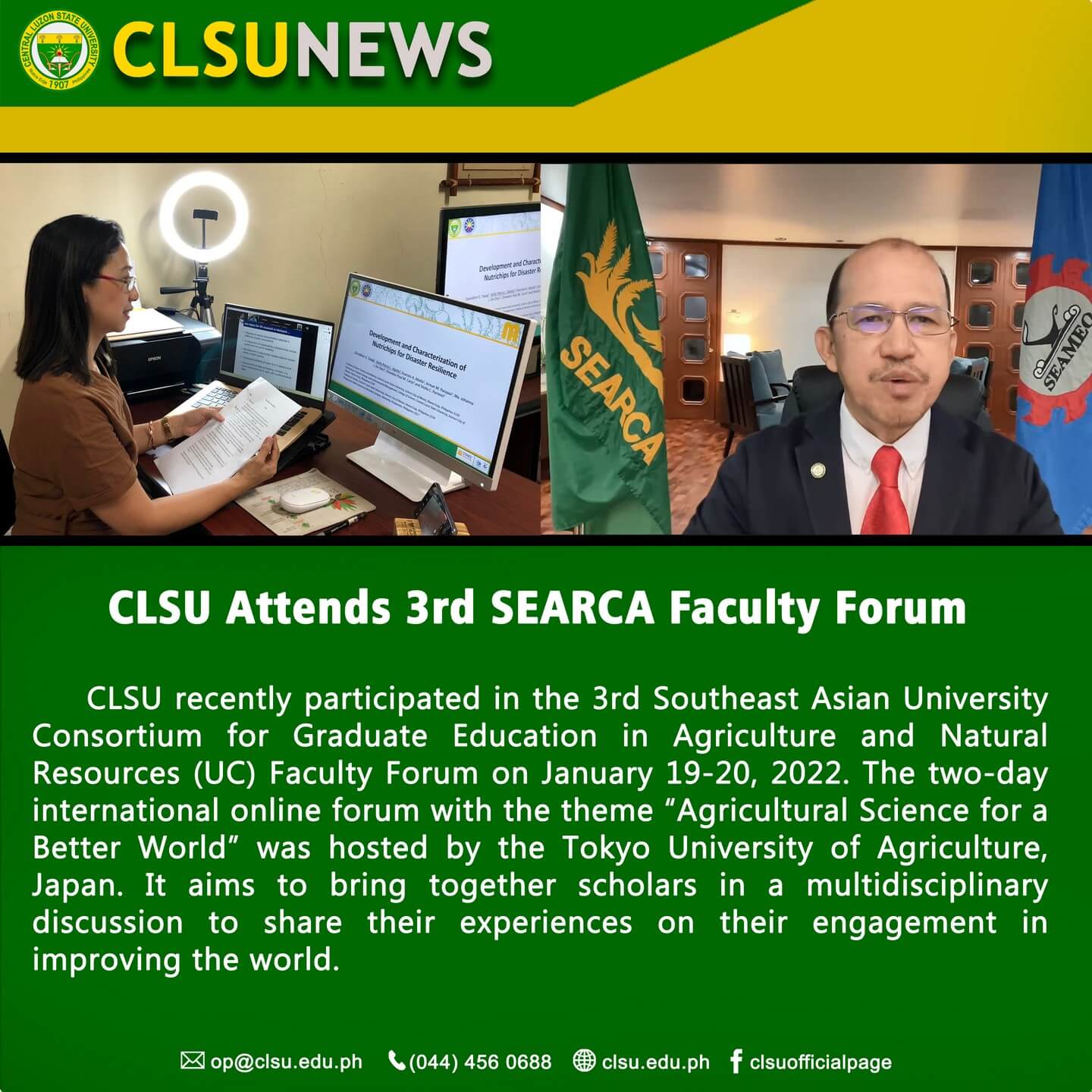
CLSU Attends 3rd SEARCA Faculty Forum

Jan. 21, 2022

Kimberly Joy E. Mata | OVPAA

CLSU participated in the recent 3rd Southeast Asian University Consortium for Graduate Education in Agriculture and Natural Resources (UC) Faculty Forum on January 19-20, 2022. The 2-day international online forum with the theme “Agricultural Science for a Better World” was hosted by the Tokyo University of Agriculture, Japan. It aims to bring together scholars in a multidisciplinary discussion to share their experiences on their engagement in improving the world. The research project “Development and Characterization of Nutrichips for Disaster Resilience,” presented by Dr. Gella Patria Abella (Project Leader) addresses the need for disaster resiliency in the communities of Anda, Pangasinan which is at risk of natural hazards such as coastal flooding and storm surge. The project intends to develop a full-packed nutrichips from the locally abundant and inexpensive raw materials such as mushroom, seaweed and moringa (malunggay). Together with Dr. Abella are Dr. Evaristo A. Abella (Program Leader, College of Science), Ms. Geraldine G. Tayag (Project Staff, College of Home Science and Industry), Dr. Arman M. Parayao (Project Staff, College of Science), Ms. Ma. Johanna J. De Dios (Project Staff, College of Science), Mr. Zhandon Paul M. Cario (Project Support Staff IV, College of Science) from Central Luzon State University (CLSU), and Dr. Shella C. Parreno (Project Staff, Pangasinan State University-Binmaley Campus (PangSU). Meanwhile, Dr. Maria Luisa Tabing-Mason (Faculty, College of Agriculture) will also present her paper, “Improvement of Legume Production through Inoculation with Indigenous Rhizobia” on January 20, 2022, Day 2, Session 3: Application of Biotechnology for Sustainable Agriculture in Asia. This study focused on the identification of potentially novel species in the Philippines and their utilization as a microbial inoculant to increase the yield of different legumes. A part of this presentation is included in the project entitled “Sequence analysis of symbiotic genes on some indigenous rhizobia as a potential inoculant for soybean production” that was approved by the CLSU Academic Research Council for 2021 with Dr. Jerwin R. Undan and Ms. Baby Lyn T. De Guzman as co-researchers. With Agricultural Science as the pillar of the world, CLSU, through its various Research, Development, and Extension (RDE) activities, joins SEARCA in the call for more science-based knowledge dissemination at all community levels by reinforcing the collaboration among its members in the fields of education and research for more transforming and changing outcomes and an improved world.

Other Stories

CLSU Demonstrates Excellence with Above-National Performance in Chemistry Licensure Exams

Central Luzon State University (CLSU) maintained its outstanding performance in the recent Chemist and Chemical Technician Licensure Examinations, surpassing national benchmarks across both examinations. In the Chemical Technician Licensure Examination, the University posted a 96.15% passing rate among first-time takers and a 100% success rate among re-examiners, totaling 27 successful examinees. This yielded an overall institutional passing rate of 96.43%, significantly outperforming the national passing rate of 76.48%. Similarly, in the Chemist Computer-Based Licensure Examination, CLSU achieved an 86.67% passing rate for first-time examinees and 83.33% for re-examiners. This resulted in an overall institutional passing rate of 85.71% with 18 successful passers, thereby exceeding the national passing rate of 76.48%. These strong results reflect CLSU's continued dedication to academic quality and strong instruction in the chemical sciences.

Oct. 20, 2026

RIDe Fest Champions Bold Innovation and Community Impact

Central Luzon State University (CLSU) officially kicked off its Research, Innovation, and Development (RIDe) Festival 2026 today, October 19, featuring a vibrant community parade followed by an engaging opening program at the Multi-Purpose Gym. In his welcome remarks, Vice President for Administration Dr. Ariel G. Mactal emphasized that research achieves true value only when it directly benefits the community. "A breakthrough becomes truly meaningful when it moves beyond discovery to become a force for positive change," Dr. Mactal noted. Representing Dr. Reynaldo V. Ebora, Dr. Fezoil Luz C. Decena, Director of the Institution Development Division at DOST-PCAARRD, shared an inspiring vision for CLSU to become a full-fledged "Education Economic Zone." She highlighted that higher education fulfills its highest purpose when it directly addresses food security, local livelihoods, and the economic well-being of the Filipino people. “When a university functions as an education economic zone, it creates a self-sustaining cycle,” Dr. Decena explained. “Academic research drives economic value, and economic growth attracts industry partnerships and private investments. Those investments then flow back into R&D infrastructure, student scholarships, and advanced scientific inquiries.” Following the opening ceremony, the university launched the RIDe Fest Expo. The showcase features interactive booths from research centers, academic colleges, agricultural partners, and government agencies, all highlighting cutting-edge breakthroughs and community-centered innovations.

Oct. 19, 2026

CLSU Joins Erasmus+ BRIDGE Study Visit on Digital Transformation in Spain

Central Luzon State University (CLSU) took part in the first study visit of the Erasmus+ funded BRIDGE (Boosting Resilience, Inclusion, and Digital Growth in Philippine Higher Education) Project, held at La Salle Campus Barcelona – Universitat Ramon Llull, Spain, on October 5–9, 2026. The CLSU delegation included Dr. Emil F. Ubaldo (Project Coordinator and Chief of Mobility and Intercultural Exchange), Dr. Khavee Augustus Botangen (Project Expert and MISO Director), and staff members Mr. Jerome O. Garcia and Mr. Ariel Joseph J. Barza. They joined delegates from Ateneo de Manila University, Polytechnic University of the Philippines, De La Salle University, and Mindanao State University–Iligan Institute of Technology, alongside virtual participants from the Commission on Higher Education, University of Patras, and ReadLab. During the sessions, Dr. Botangen presented CLSU's digital transformation framework and ongoing initiatives, while Dr. Ubaldo shared updates on the project’s dissemination campaign and Community of Practice strategy. Delegates also toured the Human-Robot Interaction and Health Lab, the Interactive Arts & Science Laboratory, and the Internet of Things Institute of Catalonia. The visit concluded with a guided cultural tour of the Basilica de la Sagrada Família. The BRIDGE Project is an Erasmus+ Capacity Building in Higher Education initiative running from November 2025 to October 2029, bringing together a consortium of higher education institutions and organizations from the Philippines, Spain, and Greece. The consortium aims to strengthen institutional capacity, promote inclusive and accessible digital education, develop industry-aligned curricula, and foster innovation in teaching, research, and campus operations.

Oct. 15, 2026

View More