op@clsu.edu.ph (044) 940 8785
CLSU Logo

Central Luzon State University

Science City of Muñoz, 3120 Nueva Ecija, Philippines

CLSU Launches First-Ever BA in International Studies in North and Central Luzon

Oct. 21, 2025

Kenn Calang | SCO

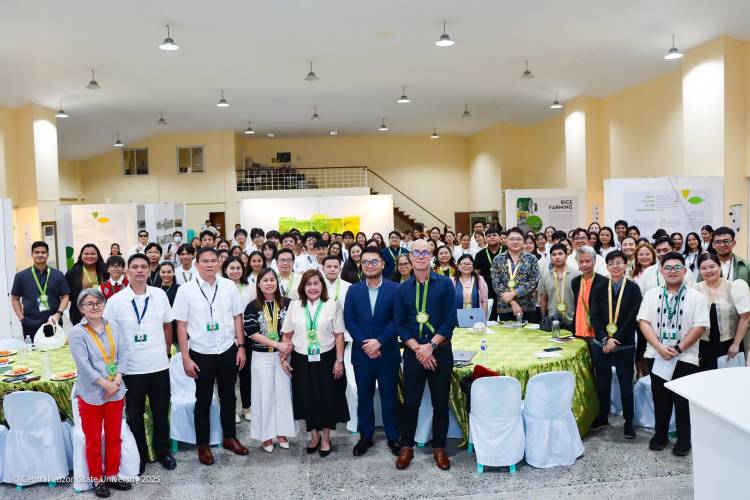
Central Luzon State University (CLSU) marked a significant milestone in higher education with the official launching of the Bachelor of Arts in International Studies – Global Sustainable Development (BAIS–GSD), the first and only program of its kind in North and Central Luzon, on October 20, 2025, at Reimers Hall, CLSU. The day-long event gathered university officials, faculty members, students, and partner institutions in a celebration of global collaboration, sustainability, and innovation in higher learning. The morning session opened with a Special Plenary Lecture titled “Sustainable Future for Whom?: Breaking Boundaries and Reimagining a Global Community” delivered by Professor Haruko Satoh from the Osaka School of International Public Policy (OSIPP), Osaka University. In her lecture, Prof. Satoh highlighted the need to broaden perspectives on sustainability, urging participants to recognize the interconnectedness of global challenges and to build inclusive approaches toward development. In the afternoon, the formal Launching of the BAIS–GSD Program took place, graced by Dr. Evaristo A. Abella, University President, who underscored CLSU’s commitment to nurturing globally competent graduates who can contribute meaningfully to sustainable development. Dr. Lora L. Yusi, Regional Director of the Commission on Higher Education (CHED) – Region III, extended her congratulations to CLSU for pioneering a program that integrates the sustainable development agenda. She also challenged the Department of Global Studies, the home of the BAIS–GSD program, to continually innovate its approaches to teaching and research, strengthen linkages with local and international partners, and ensure that sustainability and global citizenship are meaningfully embedded in the students’ learning experience. In her closing remarks, Dr. Ravelina R. Velasco, Vice President for Academic Affairs, commended the department for its vision and leadership in establishing a forward-looking program aligned with global educational goals. After the launching, participants took part in the Signing of the Commitment Board followed by a Stakeholders’ Meeting that gathered delegations from the Commission on Higher Education – Region III, Foreign Service Institute (FSI), World Vision, Philippine-American Educational Foundation (Fulbright Philippines), Philippine International Studies Organization (PHISO), Ms. Armiliza Magno, Monitoring and Evaluation Specialist - FAO, FACTS Asia, Far Eastern University, Miriam College, and the CLSU International Affairs Office, among others. During the meeting, stakeholders shared insights and expressions of support for the BAIS–GSD program, recognizing its potential to produce graduates who are not only globally aware but also locally grounded in advancing sustainable and inclusive growth. The Bachelor of Arts in International Studies – Global Sustainable Development (BAIS–GSD) program reflects CLSU’s mission to empower future leaders equipped with interdisciplinary knowledge, cross-cultural understanding, and a commitment to sustainability — shaping a new generation of global citizens ready to make a meaningful impact in their communities and beyond.

Other Stories

CLSU Secures 10 Million Pesos HUSAY Grant, Signs MOA with CHED

The Central Luzon State University (CLSU) through the Precision and Digital Agriculture Center (PreDiCt), secured a 10-million peso fund from the Commission on Higher Education (CHED), through the Higher Education Upskilling and Study for Advancement of Staff and Faculty (HUSAY) Grant for the upskilling program dubbed SPECTRA: Smart, Precision, Enhanced Digital, and Climate-Smart Technologies for Resilient Agriculture. The program is funded under the Higher Education Upskilling and Study for Advancement of Staff and Faculty (HUSAY) Program. To officially mark the implementation of the approved program, Dr. Evaristo A. Abella, CLSU President, signed a Memorandum of Agreement (MOA) with Dr. Shirley Agrupis, CHED Chairperson, held today, December 15, at the Luxent Hotel in Quezon City, in conjunction with the 2nd National Teacher Education Summit. Endorsed by Dr. Ricmar P. Aquino, Chair of the CLSU Board of Regents and Commissioner of CHED, the said grant will provide a comprehensive capacity-building initiative for SUC faculty nationwide aimed at closing the gap where most have limited exposure to essential modern technologies like drones, remote sensing, Internet-of-Things (IoT) sensors, and Artificial Intelligence. The program, which will run for a year, is designed to provide intensive, hands-on training focused on smart, precision, digital, and climate-smart agriculture enabling the trainees to produce outputs such as drone maps, IoT monitoring plans, and institutional extension proposals. Present as witnesses were Dr. Jonathan V. Fabula, CLSU PreDiCt Director and program proponent, and Atty. Cinderella Filipina S. Benitez-Jaro, CHED Executive Director IV, and other officials. #SievingForExcellence

Dec. 15, 2025

CLSU, SCNU Expand Partnership to Elevate Research and Global Competitiveness

Central Luzon State University (CLSU) welcomed a high-level delegation from Sunchon National University (SCNU), Republic of Korea, today, December 15, marking a significant step in expanding the partnership that began with the successful establishment of the King Sejong Institute (KSI) Muñoz. The delegation, which included Dr. Ki-Chang Nam, SCNU Vice President of Academic Affairs, Dr. Kang Seok Seo, Dean of the Office of International Affairs & Education, and six professors from the Department of Animal Science, was received by Dr. Karenina B. Romualdo, CLSU's Vice President for Business Affairs, as representative of University President Dr. Evaristo A. Abella. During the welcome remarks, Dr. Nam expressed profound appreciation for CLSU. He specifically lauded the successful one-year establishment of the KSI Muñoz, calling it a testament to strong university collaboration. Dr. Nam emphasized that the partnership was moving "beyond formal agreements" and into a phase of "truly practical and meaningful partnership," stating, "The steady program we have made together is a strong and confident step to grow. Once again, I would like to express my humble thanks to everyone in CLSU." Following the greetings, Dr. Ravelina R. Velasco, CLSU Vice President for Academic Affairs and Director of KSI-Muñoz, set the tone for the day's events as she declared: "Today, I believe that we will make another history by establishing the Green Smart Laboratory of the CLSU College of Agriculture, Department of Animal Science. This is another momentous event for CLSU to welcome you all.” Dr. Romualdo, on the other hand, underscored the partnership's focus on tangible impact, sharing, "We are also glad that we have heard some of the good news, apart from the establishment of the KSI Muñoz, but of course the transformation of the knowledge and technology to our community and of course to our country. So that is good news that we have a transformational partnership between the two of us.” The main agenda of the visit focused on the proposed Animal Science Joint Research Center, also called the Green Smart Farm Joint Research Center, and academic collaboration. SCNU and CLSU Animal Science faculty met to discuss the center’s establishment, research grants, funding, and co-authored research papers. Simultaneously, Dr. Kang and Dr. Mijoon Pak, SCNU Research Professor, held a separate discussion with Dr. Velasco regarding the formal operational management of the KSI-Muñoz. For the next day, the SCNU delegation will focus on engagement with CLSU's high school community, including meetings with officials and faculty of the University Science High School (USHS) and the Agricultural Science and Technology School (ASTS), along with conducting Korean Cultural Classes for their students. The visit is a promising continuation of the CLSU-SCNU collaboration, moving beyond language and cultural exchange to significant research cooperation aimed at local community benefits and international academic recognition.

Dec. 15, 2025

CLSU Produces 127 New Licensed Agricultural and Biosystems Engineers, Exceeds National Passing Rate

As one of the University’s flagship programs, the College of Engineering – Department of Agricultural and Biosystems Engineering proudly celebrates the outstanding performance of its graduates in the December 2025 Agricultural and Biosystems Engineers Licensure Examination (ABELE) where CLSU achieved an impressive 64.80% overall institutional passing rate, surpassing the national passing rate of 59.14%. The Professional Regulation Commission (PRC) released the official results on December 11, 2025, listing 127 “Golden Grains” composed of 94 first-time takers and 33 repeaters, who now join the roster of licensed Agricultural and Biosystems Engineering professionals. Congratulations to our new Licensed Agricultural and Biosystems Engineers! List of Passers: (To follow)

Dec. 12, 2025

View More