op@clsu.edu.ph (044) 940 8785
CLSU Logo

Central Luzon State University

Science City of Muñoz, 3120 Nueva Ecija, Philippines

University

CLSU STAKEHOLDERS PARTICIPATE IN THE CONSULTATION MEETING IN PREPARATION FOR THE LIMITED FACE-TO-FACE CLASSES

Dec. 12, 2021

Strategic Communication Office | SCO

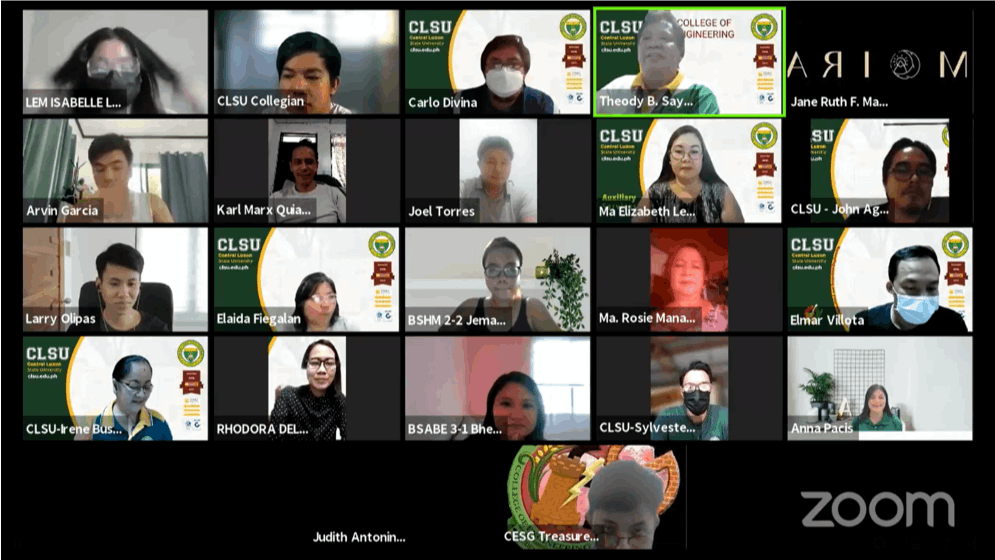
Around 1,500 student, faculty, parents, guardians, LGU officials, vendors, and other stakeholders joined the consultation meeting for the crafting of the proactive plan of Central Luzon State University (CLSU) held virtually on October 22, 2021. The public consultation activity was conducted as an initial step in preparation for the possible implementation of limited face-to-face classes in CLSU come early next year. Dr. Theody B. Sayco, Dean of the College of Engineering and Chair of the Limited Face-to-Face Committee, presented the initial plans and preparations of the University to the attendees. He emphasized that the Plan complies with the joint memorandum circular (JMC) number 2021-001 of the Department of Health (DOH) and Commission on Higher Education (CHED) on the guidelines for the gradual reopening of Higher Education Institutions (HEIs) during the COVID-19 Pandemic. According to Dr. Sayco, the selected programs under the College of Engineering (CEn) such as the Bachelor of Science in Agricultural Biosystems Engineering, Bachelor of Science in Civil Engineering, and Bachelor of Science in Information Technology, and the College of Home Science and Industry (CHSI) such as the Bachelor of Science in Hotel and Restaurant Management and Bachelor of Science in Tourism Management, will form part of the initial subjects to be offered under the limited face-to-face classes as these all require a laboratory for skills enhancement. Following the provided CHED guidelines, CLSU must satisfy the minimum health protocols to obtain accreditation which will be valid for two semesters. Other than the physical preparation and retrofitting of the facilities, those who will opt for the limited face-to-face classes must be officially enrolled senior and junior students who are at least 20 years old and fully vaccinated. “Attendance to face-to-face classes is NOT mandatory. We give our students the right to choose considering the restrictions of the situation without prejudice to their class assessment,” Dr. Sayco clarified. CLSU President Edgar A. Orden who was also present in the virtual event assured the stakeholders that the University will also be looking into the possibility of expanding the coverage of limited face-to-face classes to Veterinary Science and Medicine, Biology, Agriculture, and other courses with laboratory classes. He also added that CLSU will make the necessary proposal to CHED once the campus is ready and capable of accommodating a bigger number of students. The health protocols, the readiness of the University, the establishment of the Crisis Management Committee, the Cyclical Students Shifting Model, the Occupancy Capacity, and the Additional Health and Safety Measures were also discussed as criteria of CHED for the approval of the inclusion of additional courses in limited face-to-face classes. Part of the CLSU Proactive Plan is the inclusion that minimum health protocols will be imposed on the campus, and these include the wearing of face masks, face shields, and observance of physical distancing. While visual cues, floor markers, and physical barriers will also be put in place as an additional precaution to avoid the transmission of the virus. Moreover, right after the presentation of the initial plans, questions and clarifications from the stakeholders were accommodated and readily answered by the Committee members. Also, some students and parents provided insightful suggestions for consideration of the management in the smooth implementation of limited face-to-face classes next year. After the University has completed and submitted all the necessary documents to CHED, CLSU will be subjected to their evaluation and inspection to obtain the authority to reopen the campus for the limited face-to-face classes. The meeting ended with high hopes that the preparation of CLSU will lead to the opening of all courses for the next few months. But meanwhile, courses that are not included in the limited face-to-face classes will still observe the current flexible learning system used by the University.

Other Stories

CLSU Secures 10 Million Pesos HUSAY Grant, Signs MOA with CHED

The Central Luzon State University (CLSU) through the Precision and Digital Agriculture Center (PreDiCt), secured a 10-million peso fund from the Commission on Higher Education (CHED), through the Higher Education Upskilling and Study for Advancement of Staff and Faculty (HUSAY) Grant for the upskilling program dubbed SPECTRA: Smart, Precision, Enhanced Digital, and Climate-Smart Technologies for Resilient Agriculture. The program is funded under the Higher Education Upskilling and Study for Advancement of Staff and Faculty (HUSAY) Program. To officially mark the implementation of the approved program, Dr. Evaristo A. Abella, CLSU President, signed a Memorandum of Agreement (MOA) with Dr. Shirley Agrupis, CHED Chairperson, held today, December 15, at the Luxent Hotel in Quezon City, in conjunction with the 2nd National Teacher Education Summit. Endorsed by Dr. Ricmar P. Aquino, Chair of the CLSU Board of Regents and Commissioner of CHED, the said grant will provide a comprehensive capacity-building initiative for SUC faculty nationwide aimed at closing the gap where most have limited exposure to essential modern technologies like drones, remote sensing, Internet-of-Things (IoT) sensors, and Artificial Intelligence. The program, which will run for a year, is designed to provide intensive, hands-on training focused on smart, precision, digital, and climate-smart agriculture enabling the trainees to produce outputs such as drone maps, IoT monitoring plans, and institutional extension proposals. Present as witnesses were Dr. Jonathan V. Fabula, CLSU PreDiCt Director and program proponent, and Atty. Cinderella Filipina S. Benitez-Jaro, CHED Executive Director IV, and other officials. #SievingForExcellence

Dec. 15, 2025

CLSU, SCNU Expand Partnership to Elevate Research and Global Competitiveness

Central Luzon State University (CLSU) welcomed a high-level delegation from Sunchon National University (SCNU), Republic of Korea, today, December 15, marking a significant step in expanding the partnership that began with the successful establishment of the King Sejong Institute (KSI) Muñoz. The delegation, which included Dr. Ki-Chang Nam, SCNU Vice President of Academic Affairs, Dr. Kang Seok Seo, Dean of the Office of International Affairs & Education, and six professors from the Department of Animal Science, was received by Dr. Karenina B. Romualdo, CLSU's Vice President for Business Affairs, as representative of University President Dr. Evaristo A. Abella. During the welcome remarks, Dr. Nam expressed profound appreciation for CLSU. He specifically lauded the successful one-year establishment of the KSI Muñoz, calling it a testament to strong university collaboration. Dr. Nam emphasized that the partnership was moving "beyond formal agreements" and into a phase of "truly practical and meaningful partnership," stating, "The steady program we have made together is a strong and confident step to grow. Once again, I would like to express my humble thanks to everyone in CLSU." Following the greetings, Dr. Ravelina R. Velasco, CLSU Vice President for Academic Affairs and Director of KSI-Muñoz, set the tone for the day's events as she declared: "Today, I believe that we will make another history by establishing the Green Smart Laboratory of the CLSU College of Agriculture, Department of Animal Science. This is another momentous event for CLSU to welcome you all.” Dr. Romualdo, on the other hand, underscored the partnership's focus on tangible impact, sharing, "We are also glad that we have heard some of the good news, apart from the establishment of the KSI Muñoz, but of course the transformation of the knowledge and technology to our community and of course to our country. So that is good news that we have a transformational partnership between the two of us.” The main agenda of the visit focused on the proposed Animal Science Joint Research Center, also called the Green Smart Farm Joint Research Center, and academic collaboration. SCNU and CLSU Animal Science faculty met to discuss the center’s establishment, research grants, funding, and co-authored research papers. Simultaneously, Dr. Kang and Dr. Mijoon Pak, SCNU Research Professor, held a separate discussion with Dr. Velasco regarding the formal operational management of the KSI-Muñoz. For the next day, the SCNU delegation will focus on engagement with CLSU's high school community, including meetings with officials and faculty of the University Science High School (USHS) and the Agricultural Science and Technology School (ASTS), along with conducting Korean Cultural Classes for their students. The visit is a promising continuation of the CLSU-SCNU collaboration, moving beyond language and cultural exchange to significant research cooperation aimed at local community benefits and international academic recognition.

Dec. 15, 2025

CLSU Produces 127 New Licensed Agricultural and Biosystems Engineers, Exceeds National Passing Rate

As one of the University’s flagship programs, the College of Engineering – Department of Agricultural and Biosystems Engineering proudly celebrates the outstanding performance of its graduates in the December 2025 Agricultural and Biosystems Engineers Licensure Examination (ABELE) where CLSU achieved an impressive 64.80% overall institutional passing rate, surpassing the national passing rate of 59.14%. The Professional Regulation Commission (PRC) released the official results on December 11, 2025, listing 127 “Golden Grains” composed of 94 first-time takers and 33 repeaters, who now join the roster of licensed Agricultural and Biosystems Engineering professionals. Congratulations to our new Licensed Agricultural and Biosystems Engineers! List of Passers: (To follow)

Dec. 12, 2025

View More