

op@clsu.edu.ph (044) 940 8785
CLSU Logo

Central Luzon State University

Science City of Muñoz, 3120 Nueva Ecija, Philippines

University

TURN YOUR WASTES INTO FERTILIZERS

Dec. 10, 2021

Clarizza Ann G. Lagasca | PMO

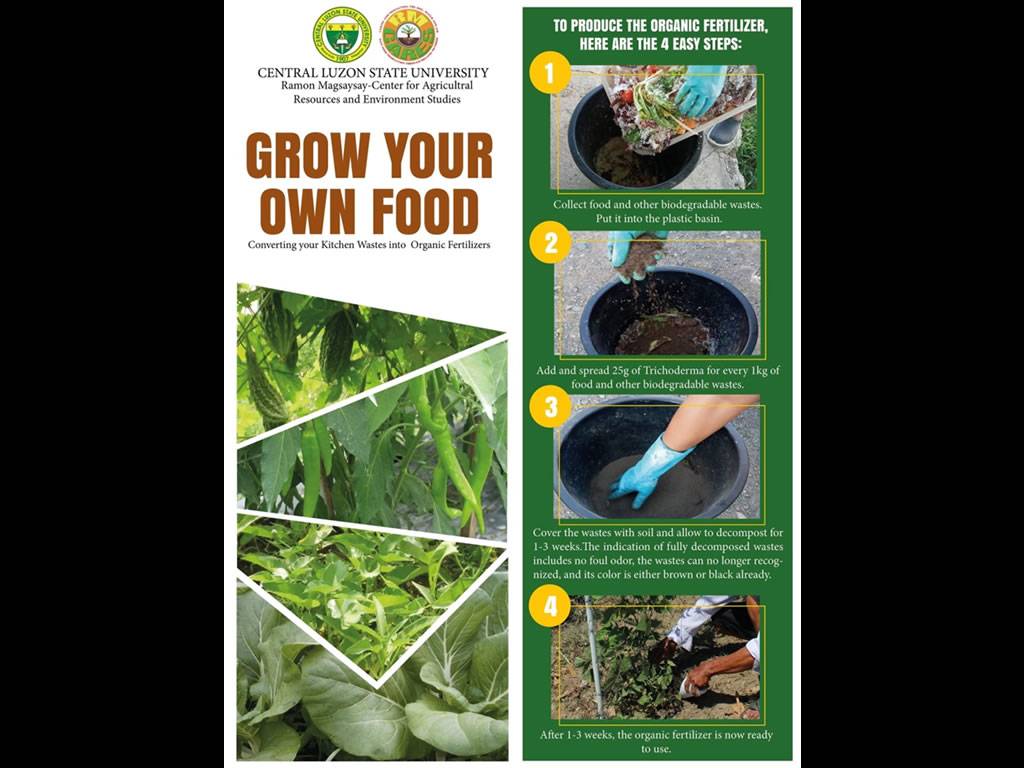
To ensure a sustained food production and availability, food accessibility and affordability amidst the CoViD-19 pandemic crisis, the Department of Agriculture (DA) recently launched the “Plant, Plant, Plant Program” that encourages every Juan to grow their own food. Part and parcel of the program is the distribution of seedlings; however inputs such as fertilizers and pest control agents are the counterpart of every participant. In view of developing local and cheap source of fertilizer, the Central Luzon State University through the Ramon Magsaysay Center for Agricultural Resources and Environment Studies (CLSU - RM-CARES) espouses the utilization of kitchen or food wastes as nutrient source for the plants through conversion into organic fertilizers. According to Dr. Jonathan Galindez, RM-CARES Director, food wastes such as vegetable, fruit peelings and leftovers, are composed of organic matter which can be composted to produce nutrient-rich organic fertilizers. Production of the said organic fertilizers involves four easy steps as follows: 1. Collect food and other biodegradable wastes. Put it into the plastic basin. 2. Add and spread 25g of Trichoderma for every 1kg of food and other biodegradable wastes. 3. Cover the wastes with soil and allow it to decompose for 1-3 weeks. The indications of fully decomposed wastes include absence of foul odor, unrecognized waste appearance and color being either brown or black already. 4. After 1-3 weeks, the organic fertilizer is now ready to use. Speeding up decomposition period requires the use of Trichoderma, a product of RM-CARES. Normal decomposition takes 1-1½ months but the use of Trichoderma shortens it to 1-3 weeks. In addition, to foster the ‘bayanihan’ spirit in the midst of the CoViD-19 crisis, the RM-CARES team continuously provides fresh and organic vegetables to the CLSU Community, including the stranded students, as one of the means to boost and improve the immune system of the constituents. For more information, visit the CLSU website at https://clsu.edu.ph.

Other Stories

CLSU Kickstarts SIBOL 2026 to Empower Student Incubatees

Central Luzon State University (CLSU) through the Agriculture and Food Technology Business Incubator (AFTBI) formally commenced the SIBOL 2026: Nurturing Ideas, Growing Innovations, Creating Impact: Empowering Student Incubatees to Build Sustainable and Innovative Ventures, today, September 14, through a Ceremonial Memorandum of Agreement (MOA) Signing, marking a significant step toward strengthening student innovation and entrepreneurship within the University. Organized in partnership with the Commission on Higher Education (CHED) and the Department of Science and Technology–Philippine Council for Agriculture, Aquatic and Natural Resources Research and Development (DOST-PCAARRD), the program equips student incubatees with startup mentorship, financial modeling, intellectual property guidance, and technical evaluation. The ceremonial signing was led by University President Dr. Evaristo A. Abella, with Dr. Celyrah B. Castillo, Dean of the College of Home Science and Industry (CHSI); Dr. Pablo J. Rafael, Jr., CHED CLSU-SIBOL Project Leader; Dr. Dana G. Vera Cruz, CHED CLSU-SIBOL Project Staff; Dr. Joel G. Juvinal, Assoc. Prof. Geraldine G. Tayag, and Asst. Prof. Jennylyne L. Joaquin, CHED CLSU-SIBOL Mentors and Resource Speakers; Dr. Jessica M. Rustia and Instructor Kim Aron Velasco, CHED CLSU-SIBOL Mentors; and Assoc. Prof. Celeste D. Dela Cruz, Head of the Department of Tourism and Hospitality Management (DTHM), together with the thirteen student incubatees and their parents and guardians. In his message, President Abella encouraged the student incubatees to make the most of the experience. “Your ideas may still be at their beginning stages, but with proper guidance and your willingness to learn, these ideas can grow into innovations that will definitely create impact in our community,” he stated. Following the ceremonial signing, the 13 student incubatees from the Bachelor of Science in Hospitality Management (BSHM) and Bachelor of Science in Food Technology (BSFT) began a three-day training workshop featuring a series of learning sessions designed to strengthen their competencies and equip them for the further development and commercialization of their innovative ideas. Through this collaboration, CLSU, CHED, and DOST-PCAARRD continue to empower the next generation of innovators and entrepreneurs to identify opportunities, address challenges, and develop solutions responsive to the needs of communities and industries.

Sep. 14, 2026

CLSU Reaps 2 Awards for Sustainable Tourism at 2026 CL Star Awards

Central Luzon State University (CLSU) earned two recognitions during the 2026 Central Luzon Star Awards held on September 10, 2026, at the Subic Bay Exhibition and Convention Center. CLSU was recognized as the winner for Sustainable Tourism Education Leadership under the State Universities and Colleges Category, affirming the university’s commitment to promoting quality and sustainable tourism education and its continued contribution to the development of the tourism industry. Moreover, CLSU was also declared the Overall Destination Stewardship Champion, highlighting its continued commitment to responsible tourism and destination stewardship. The awards were received by Dr. Celyrah B. Castillo, Dean of the College of Home Science and Industry (CHSI), and Assoc. Prof. Celeste D. Dela Cruz, Chair of the Department of Hospitality and Tourism Management (DHTM), together with other faculty members from the CHSI – DHTM, who represented the university during the ceremony. These recognitions reflect the dedication of CLSU to excellence in tourism education and its efforts to contribute to the advancement of sustainable tourism in Central Luzon and beyond. #SievingForExcellence

Sep. 11, 2026

CLSU Graduate Programs Eye Approval for Level IV Accreditation

The graduate programs under the Institute of Graduate Studies (IGS) underwent a comprehensive three-day Level IV, 2nd Cycle accreditation survey visit conducted by the Accrediting Agency of Chartered Colleges and Universities in the Philippines (AACCUP) from September 2 to 4, 2026. The rigorous evaluation covered eight advanced degree programs: Master in Agribusiness, Master of Science in Agricultural Economics, Master of Science in Crop Protection, Master of Science in Animal Science, Master of Science in Crop Science, Master of Science in Soil Science, Doctor of Philosophy in Animal Science, and Doctor of Philosophy in Crop Science. During the closing program, Dr. Edgardo P. Lillo delivered the overall impression on behalf of the accrediting team, commending the college for sustaining high standards while maintaining the unique identity of each academic program. Dr. Lillo further highlighted key strengths including high-quality international research publications, strong alumni employability, active community engagement, highly qualified faculty roster, growing portfolio of patents and copyrights, state-of-the-art facilities, and robust local and international partnerships. In response, University President Dr. Evaristo A. Abella, represented by Vice President for Academic Affairs Dr. Ravelina R. Velasco, delivered the Pledge of Commitment, expressing deep gratitude to the AACCUP accreditors and the internal task force for their thorough evaluation. “We shall listen, learn, evaluate, innovate, and improve. As the CLSU community, we pledge to commit to quality, to lead with integrity and excellence, to serve with purpose and compassion, and to continuously pursue an unending journey of excellence,”

Sep. 04, 2026

View More