

op@clsu.edu.ph (044) 940 8785
CLSU Logo

Central Luzon State University

Science City of Muñoz, 3120 Nueva Ecija, Philippines

Academic

CF, FAC Continue the Ecological Assessment of Sumacbao River in Minalungao National Park

Apr. 21, 2022

Stratcom | SCO

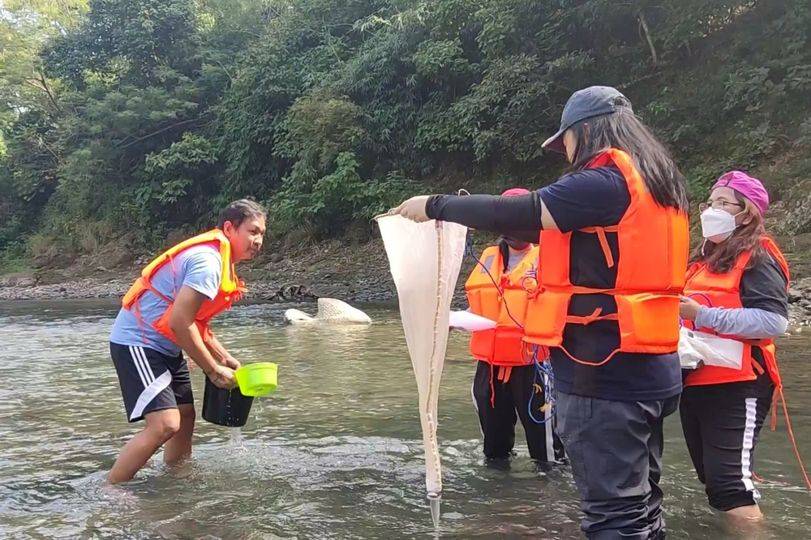
A group of researchers and students from the College of Fisheries (CF) and Freshwater Aquaculture Center (FAC) spearheaded an ecological assessment of the Sumacbao River that traverses the Minalungao National Park in General Tinio, Nueva Ecija on November 20, 2021. The group was headed by Dr. Ravelina R. Velasco, CF Acting Dean and SDG 14 Lead (Life Below Water) together with Department Heads and Project Leads, Dr. Lorenz J. Fajardo and Dr. Alvin T. Reyes. Joining the pool of experts were Mr. Jaypee S. Samson, Mr. Jhon Christian P. Suyom, Mr. Ismael P. Geroza, and Ms. Twinkle G. Barangan. The Minalungao National Park was declared a protected area through Republic Act 51000 on June 17, 1967.    The monitoring activity is part of the CF/FAC's extension/community service and Area-based Management Plan implemented by the Department of Environment and Natural Resources (DENR) – Provincial Environment and Natural Resources Office Nueva Ecija.  Three sampling stations were strategically established along the Sumacbao River for on-site analysis of physical water quality parameters using multi-parameter equipment. Additional water samples were collected from the same sites for analysis of chemical water parameters and general assessment of biological components such as plankton and coliform in the laboratory. The collected data were compared to the prescribed water quality standards set by DENR – Environmental Management Bureau.    Results of monitoring showed that water quality parameters such as temperature, total dissolved solids, pH, hardness, alkalinity, total ammonia nitrogen, phosphorus, nitrate, and total coliform count were within the desirable ranges set by the DENR-EMB. This means that the river water is suitable for use under Class B (recreational) and Class C (propagation and growth of fish and other aquatic resources). Based on initial identification, major plankton species in the river include Actinastrum, Melosira, and Ceratium.   To further strengthen and continue the monitoring activities of CLSU-CF in Sumacbao River, a Memorandum of Agreement between involved parties was renewed last October 2021. 

Other Stories

CLSU Spearheads Tree-Planting Activity of CLAARRDEC to Kick-off its Golden Anniversary

Early this morning, July 3, the Central Luzon State University (CLSU), serving as the base agency of the Central Luzon Agriculture, Aquatic, and Natural Resources Research and Development Consortium (CLAARRDEC), spearheaded a tree-planting activity to officially kick off the Consortium’s pre-celebration of its 50th Founding Anniversary. Held in partnership with the Local Government Unit of Carranglan, Nueva Ecija, the activity was graced by Hon. Ricardo Manucdoc, Vice Mayor of Carranglan, who joined and led the volunteers in planting more than a thousand robusta coffee seedlings. In his message, Vice Mayor Manucdoc shared that the municipality has been conducting similar initiatives since 2022 as part of its efforts to rehabilitate mountain areas devastated by forest fires. “Nagpapasalamat kami dahil ang CLSU ay laging tumutugon sa ating mga pangangailangan at adbokasiya,” said Vice Mayor Manucdoc. “Kami po ay aasahan ninyong maging kapartner sa mga ganitong adhikain,” he added, reaffirming the municipality’s commitment to environmental stewardship and sustainable partnerships. Around 50 participants from CLSU and CLAARRDEC took part in the activity, led by Dr. Evaristo A. Abella, University President and Chair of the CLAARRDEC Regional Research and Development Coordinating Council, together with Dr. Emmanuel M. Vera Cruz, Vice President for Research, Innovation and Extension and Consortium Director; Mr. Neal A. Del Rosario, Director of the Small Ruminant Center and Consortium Deputy Director; and Assoc. Prof. Maria Adrielle S. Estigoy, Presidential Assistant for Strategic Communication and Regional Science Communication Cluster Coordinator. In his message, President Abella expressed his gratitude to the LGU of Carranglan for warmly welcoming CLSU and CLAARRDEC, emphasizing that the activity gave greater significance to the Consortium’s golden anniversary celebration. “Natutuwa po kami sa patuloy ninyong pagbahagi sa aming gawain. We continue to be partners for development,” he stressed. Anchored on the theme, “CLAARRDEC at 50: Connecting Science, Society, and Sustainability,” the tree-planting initiative symbolizes the Consortium’s enduring commitment to advancing sustainable development in agriculture, fisheries, environment, and natural resources. The planting of more than five hundred robusta coffee seedlings reflects CLAARRDEC’s continuing efforts to promote environmental conservation while strengthening partnerships with local communities. The activity was further supported by various civic organizations and vloggers/influencers and was made possible through the assistance of the CLSU Center for Climate Change and Environmental Management. In solidarity with the celebration, other CLAARRDEC member institutions will likewise conduct a tree-planting activity in their respective areas, demonstrating the Consortium’s shared commitment to sustainability and environmental conservation as it marks five decades of service to the region.

Jul. 03, 2026

CLSU Hosts 8 International Students for Filipino Language and Cultural Immersion

Central Luzon State University (CLSU) has opened its doors to eight international students from prestigious universities in the United States for a firsthand, immersive experience of the Filipino language, culture, and community traditions. The foreign delegates, who comprise four students from Harvard University, three from Northern Illinois University, and one from the University of California, Berkeley, are participating in two specialized tracks: the International Filipino Language and Culture Program and the Green and Global Philippines: Language, Culture, and Sustainability program. Led by the International Affairs Office (IAO), this short-term immersion is a collaborative effort with the College of Arts and Social Sciences (CASS), specifically through the Department of Filipino and the Department of Global Studies. The initiative aims to foster deep cross-cultural understanding while offering the delegates an authentic taste of Filipino academic and community life. Upon their arrival, the international students immediately engaged with local customs. One of their first cultural activities was a trip to the local market for a traditional “pamamalengke.” The students received a quick lesson in haggling and successfully navigated the “tawad” culture while interacting with local vendors. Furthermore, the students traveled to nearby communities to learn the intricate art of community-based Sabutan Weaving, practicing the traditional craft alongside local artisans. They also immersed themselves in local spiritual traditions by participating in the unique Taong Putik Festival. In the coming weeks, the international students will participate in various cultural and agricultural activities, including rice planting, goat and carabao milking, and exploring heritage and historic sites across Luzon. The Green and Global Philippines: Language, Culture, and Sustainability program will run until July 3, 2026, while the International Filipino Language and Culture Program will continue until July 25, 2026. Through this collaborative effort, CLSU continues to strengthen its internationalization milestones and solidify its reputation as a leading hub for global academic exchange. By attracting top scholars from world-renowned institutions, the university demonstrates its capacity to bridge local heritage with impactful global education.

Jun. 25, 2026

CLSU Ascends in the 2026 THE Impact Rankings, Secures Place in the 601–800 Band

Driven by its steadfast commitment to sustainability and global development, Central Luzon State University (CLSU) has successfully reclaimed the 601-800 overall ranking in the prestigious Times Higher Education (THE) Impact Rankings 2026. This year’s edition evaluated 1,646 universities across 116 countries and territories. This achievement rests on CLSU's standout initiatives in SDG 2 (Zero Hunger) and SDG 14 (Life Below Water)—a direct result of the collective hard work, synergy, and dedication of the entire university network. The university’s strategic initiatives yielded impressive placements across various sustainable development frontiers: SDG 17: Partnership for the Goals 801-1000 SDG 2: Zero Hunger 201-300 SDG 3: Good Health and Well Being 1001+ SDG 4: Quality Education 401-600 SDG 5: Gender Equality 401-600 SDG 7: Affordable and Clean Energy 601-800 SDG 11: Sustainable Cities and Communities 601-800 SDG 13: Climate Action 601-800 SDG 14: Life Below Water 201-300 SDG 15: Life on Land 401-600 University President Dr. Evaristo A. Abella commended the faculty and staff for their dedication, noting that their passion and concrete initiatives are what drive CLSU's success in global sustainability. As CLSU continues to carve its path on the global stage, this achievement serves as both a milestone and a mandate. Moving forward, the university remains steadfast in its mission to innovate, collaborate, and lead initiatives that not only elevate its academic standing but also create a sustainable impact globally. #SievingForExcellence

Jun. 24, 2026

View More