op@clsu.edu.ph (044) 940 8785
CLSU Logo

Central Luzon State University

Science City of Muñoz, 3120 Nueva Ecija, Philippines

10 Universities in Southeast Asia join CLSU’s flagship International Mobility Program with SEARCA and University Consortium

Jul. 24, 2024

Parsons N. Hail | IAO

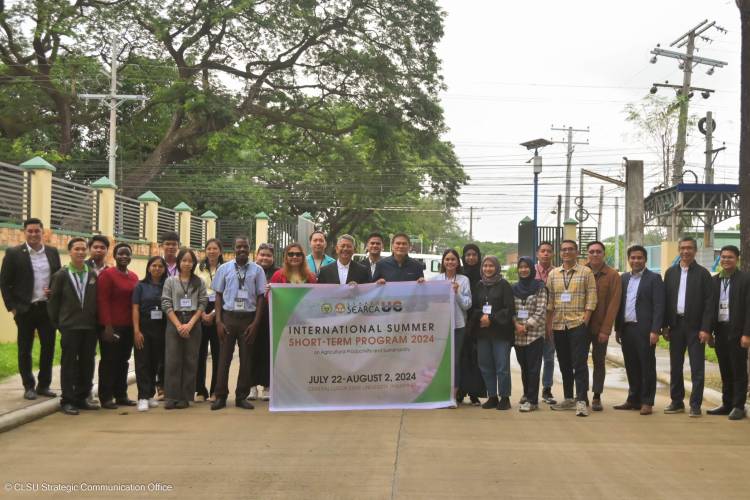
A total of 10 universities from across Southeast Asia are participating in this year’s edition of the International Summer Short-Term Program on Agricultural Productivity and Sustainability on the university campus for the next two weeks until August 2. The fourth installment of this international mobility program is a joint activity of the Central Luzon State University and the Southeast Asian Regional Center for Graduate Study and Research in Agriculture (SEARCA) and the Southeast Asian University Consortium for Graduate Education in Agriculture and Natural Resources (University Consortium) The participating universities from the University Consortium include Universitas Gadjah Madah (Indonesia), Universiti Putra Malaysia (Malaysia), IPB University (Indonesia), Maejo University (Thailand), Visayas State University, University of the Philippines Los Banos and Central Luzon State University. Participants from these universities received travel support grants from the University Consortium. Outside the consortium, this year’s participants came from Mae Fah Luang University (Thailand), An Giang University (Vietnam), Universiti Malaysia Sabah (Malaysia), and Universitas Pakuan (Indonesia). During the opening ceremony on July 22, President Evaristo A. Abella of CLSU emphasized the crucial importance of sustaining the collaborative International Mobility Program, underscoring its role in preparing youth and future leaders in agriculture for sustainable leadership, highlighting CLSU’s commitment to promoting mutually beneficial cooperation among member institutions, and optimizing collective consortium resources through robust linkages in collaborative research projects and student mobility opportunities to address multiple sustainable development goals. Ms. Blessie Saez, Senior Program Associate, Education and Collective Learning Department of SEARCA, represented both the SEARCA and the University Consortium during the event and also provided an overview of both organizations and the available opportunities for graduate students as well as university staff. She also led the learning materials donation to the University Library from the SEARCA publications. In her recorded message, Dr. Nur Azura Binti Adam, Deputy Director of SEARCA, encouraged participants to make the most out of this program by actively participating in all activities, showing their insights, and building and expanding their professional network. She emphasized that their involvement would enhance both their academic and professional growth and contribute to developing sustainable solutions to pressing challenges in the agriculture sector. Dr. Ravelina R. Velasco, Vice President for Academic Affairs and UC Executive Officer, gave the participants an overview of the previous three editions of the international program. Dr. Parsons N. Hail, Director of the International Affairs Office, gave an overview of the program while Dr. Emil F. Ubaldo, Chief of the Mobility and Intercultural Exchange Unit, introduced the participating universities. Also present during the opening ceremony was Dr. Edgar A. Orden, the immediate past president of CLSU and current Vice President for Research and Extension. Dr. Orden, a leading scientist in goat research in the Philippines, will serve as the featured speaker in the track on Efficient and Sustainable Goat Production. Over the course of two weeks, the 18 participants from different Southeast Asian universities were enrolled in sustainable aquaculture, mushroom pharming, and goat farming tracks run by CLSU’s specialized R&D centers including the Freshwater Aquaculture Center, Center for Tropical Mushroom Research and Development Center, and the Small Ruminant Center. The International Affairs Office and the Office of the Vice President for Academic Affairs are the overall lead units of the University in this program.

Other Stories

CHED Region III Brings Scholarship Caravan to CLSU

The Commission on Higher Education (CHED) Regional Office III successfully conducted its Information Caravan at Central Luzon State University (CLSU) on July 28, delivering crucial, targeted updates on government-funded academic opportunities designed for both undergraduate students and university employees. The event was organized as an immediate response to a request from the university to bring crucial details regarding government-funded educational opportunities directly to the campus community. During the opening remarks, Dr. Ravelina R. Velasco, Vice President for Academic Affairs, emphasized that education serves as a powerful tool for transforming lives and building a better future. She noted that while financial hurdles often complicate the pursuit of higher degrees, scholarships reward students who possess merit, potential, and a willingness to work hard. CHED Regional Director Dr. Maura Consolacion D. Cristobal explained that the caravan aims to deliver "pag-asa" (hope) to students facing financial deficits, particularly those managing high living and commuting expenses despite the availability of free tuition. The caravan highlighted several undergraduate and institutional grants under CHED's "ACHIEVE" national agenda, focusing primarily on advanced, accessible lifelong learning and efficient public service. For more details, visit the CHED Region 3 page at https://www.facebook.com/CHEDRegionalOffice3.

Jul. 29, 2026

CLSU, NAPC, UMANE Hold Symposium and Policy Forum on Food Security

The National Anti-Poverty Commission (NAPC) and the Utak Magsasaka Novo Ecijano (UMANE), in collaboration with Central Luzon State University (CLSU), convened a Symposium and Policy Forum on the Right to Adequate Food: Policy, Practice, and Human Dignity today, July 28, at the University Auditorium. The event gathered over 350 farmers, agricultural representatives, students, partner organizations, and guests who were eager to explore updated agricultural policies, legislation, best practices, and support programs of the government for Filipino farmers. Specifically, the event analyzed the policy framework and provided a direct platform for smallholder farmers and basic sectors to articulate structural challenges regarding market access, fair pricing, and production inputs; leveraged CLSU’s research in climate-resilient agriculture, biotechnology, and sustainable farming systems to offer scalable solutions; and to formulate a multi-sectoral "Nueva Ecija Declaration on the Right to Adequate Food" to serve as a policy brief for local and national lawmakers. During the opening program, CLSU President Dr. Evaristo A. Abella reaffirmed the university’s dedication to farmers as primary stakeholders. "This symposium is both timely and significant because it provides a venue where policymakers, researchers, agricultural experts, community leaders, and farmers can engage in meaningful dialogue. More importantly, it creates an opportunity to share ideas and recommendations that truly address the needs of our community. As a premier agricultural university, we remain steadfast in our commitment to advancing research, innovation, and extension programs that contribute directly to sustainable agricultural and rural development." Representing Nueva Ecija Governor Hon. Aurelio M. Umali as a keynote speaker, Atty. Jose Maria Caesar C. San Pedro highlighted key provincial initiatives, including the P20-per-kilo rice program, the promotion of biochar technology, and direct rice purchasing from local farmers. He emphasized that these programs aim to put people at the center of agricultural growth: "Ang tunay na sukatan ng ating tagumpay ay hindi lamang kung gaano karaming palay, sibuyas, o gulay ang ating naaani. Ang sukatan ay kung ang mga magsasaka ay may disenteng kita, kung ang bawat pamilya ay may sapat at masustansyang pagkain, at kung ang ating agricultural abundance ay nagiging oportunidad, seguridad, at dignidad para sa ating mga mamamayan,” he added. Distinguished guests and dignitaries in attendance included NAPC Lead Convenor Sec. Lope B. Santos III; Science City of Muñoz Mayor Hon. Baby Armi L. Alvarez, represented by OIC Municipal Agriculturist Mr. Leonel P. Parugrug; Department of Agriculture Regional Field Office 3 Regional Technical Director for Operations Dr. Arthur D. Dayrit; former CLSU President and current Umane, Inc. President Dr. Rodolfo C. Undan; and Philippine Carabao Center Executive Director III Dr. Liza G. Battad.

Jul. 28, 2026

CLSU Signs MOA with 7 Partners to Advance Food Processing and Livelihood Development

Central Luzon State University (CLSU), through the extension efforts of the College of Home Science and Industry (CHSI), signed a Memorandum of Agreement with seven partner institutions and community enterprises under the UNLAD PAMILYA Program, which aims to strengthen community livelihoods through food processing and value addition on July 21, 2026. Under the agreement, CLSU will provide professional and technical assistance on food processing, culinary arts, handicraft production, entrepreneurship, marketing, and business planning. The University will also designate faculty experts, provide training facilities and necessary logistical support, and regularly monitor and evaluate the progress and outcomes of the livelihood initiatives. For an academic institution, the partnership will cover capability building in academic and research areas for its students and faculty. The partner-beneficiaries are Divina Pastora College (Gapan City), Community Visions and Initiatives of Nueva Ecija Guimba, Nueva Ecija), Carranglan Multi-purpose Producers Cooperative, Hacienda T&C Food Processing (San Antonio, Nueva Ecija), K-D Nature Farm (Rizal, Nueva Ecija), Greenfields Christian Farmer Agriculture Cooperative (Munoz), and Department of Agriculture - Philippine Rice Research Institute through its partner Pinagbuklod na Adhikain Multi-purpose Cooperative. The initiative demonstrated CLSU’s mission to connect academic expertise with community stakeholders, driving sustainable livelihoods through value-added agricultural products and supporting the university's goal toward becoming an Education Economic Zone.

Jul. 23, 2026

View More