

op@clsu.edu.ph (044) 940 8785
CLSU Logo

Central Luzon State University

Science City of Muñoz, 3120 Nueva Ecija, Philippines

CLSU, OWWA Empower OFWs through Mushroom Pharming Training under the HOPE Project

Nov. 26, 2024

Laurence Lingat | OSA

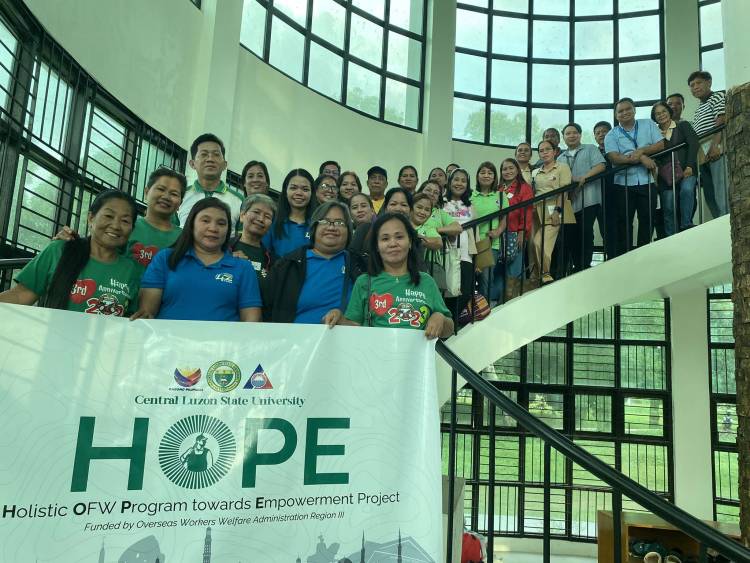
Aiming to equip Overseas Filipino Workers (OFWs) and their families with valuable skills for livelihood ventures, Central Luzon State University (CLSU) conducted an Intensive Training on Mushroom and Spawn Production (Mushroom Pharming) on November 13-14, 2024. The training marked Phase I (Batch I) of the Holistic OFW Program towards Empowerment (HOPE) Project, funded by the Overseas Workers Welfare Administration (OWWA) Region III. This initiative directly benefited members of the OFW Family Circle Federation of Nueva Ecija, equipping them with valuable skills and opportunities for livelihood development. The HOPE Project, launched as an outcome of the CLSU OFW Conference 2024, aims to support OFWs in transitioning to sustainable livelihoods through comprehensive capability-building initiatives. These include mushroom pharming, organic agriculture, personal finance management, and entrepreneurship. The training introduced the fundamentals of mushroom and spawn production, offering hands-on learning and technical guidance to prepare them for income-generating opportunities. With practical skills and entrepreneurial insights, participants were poised to make meaningful contributions to their communities while navigating life beyond overseas employment. The HOPE Project highlights the shared commitment of CLSU and OWWA to delivering impactful programs that empower OFWs to achieve long-term stability and self-sufficiency. Phases I (Batch 2) and II are scheduled for December 5-7, offering additional sessions designed to enhance participants? knowledge and skills further. The CLSU team, led by Prof. Janet O. Saturno and project leader Dr. Jayson L. Marzan, along with project staff members Dr. Elizabeth Bajit, Dr. Irene G. Bustos, Dr. Carolyn P. Gonzales-Marzan, Mr. Sherwin Celestino, Mr. Ryan De Quina, and Mr. Laurence Lingat, aimed to address the unique challenges faced by OFWs during reintegration. Their efforts focused on fostering resilience and adaptability, equipping participants with the skills needed for sustainable success.

Other Stories

CLSU Demonstrates Excellence with Above-National Performance in Chemistry Licensure Exams

Central Luzon State University (CLSU) maintained its outstanding performance in the recent Chemist and Chemical Technician Licensure Examinations, surpassing national benchmarks across both examinations. In the Chemical Technician Licensure Examination, the University posted a 96.15% passing rate among first-time takers and a 100% success rate among re-examiners, totaling 27 successful examinees. This yielded an overall institutional passing rate of 96.43%, significantly outperforming the national passing rate of 76.48%. Similarly, in the Chemist Computer-Based Licensure Examination, CLSU achieved an 86.67% passing rate for first-time examinees and 83.33% for re-examiners. This resulted in an overall institutional passing rate of 85.71% with 18 successful passers, thereby exceeding the national passing rate of 76.48%. These strong results reflect CLSU's continued dedication to academic quality and strong instruction in the chemical sciences.

Oct. 20, 2026

RIDe Fest Champions Bold Innovation and Community Impact

Central Luzon State University (CLSU) officially kicked off its Research, Innovation, and Development (RIDe) Festival 2026 today, October 19, featuring a vibrant community parade followed by an engaging opening program at the Multi-Purpose Gym. In his welcome remarks, Vice President for Administration Dr. Ariel G. Mactal emphasized that research achieves true value only when it directly benefits the community. "A breakthrough becomes truly meaningful when it moves beyond discovery to become a force for positive change," Dr. Mactal noted. Representing Dr. Reynaldo V. Ebora, Dr. Fezoil Luz C. Decena, Director of the Institution Development Division at DOST-PCAARRD, shared an inspiring vision for CLSU to become a full-fledged "Education Economic Zone." She highlighted that higher education fulfills its highest purpose when it directly addresses food security, local livelihoods, and the economic well-being of the Filipino people. “When a university functions as an education economic zone, it creates a self-sustaining cycle,” Dr. Decena explained. “Academic research drives economic value, and economic growth attracts industry partnerships and private investments. Those investments then flow back into R&D infrastructure, student scholarships, and advanced scientific inquiries.” Following the opening ceremony, the university launched the RIDe Fest Expo. The showcase features interactive booths from research centers, academic colleges, agricultural partners, and government agencies, all highlighting cutting-edge breakthroughs and community-centered innovations.

Oct. 19, 2026

CLSU Joins Erasmus+ BRIDGE Study Visit on Digital Transformation in Spain

Central Luzon State University (CLSU) took part in the first study visit of the Erasmus+ funded BRIDGE (Boosting Resilience, Inclusion, and Digital Growth in Philippine Higher Education) Project, held at La Salle Campus Barcelona – Universitat Ramon Llull, Spain, on October 5–9, 2026. The CLSU delegation included Dr. Emil F. Ubaldo (Project Coordinator and Chief of Mobility and Intercultural Exchange), Dr. Khavee Augustus Botangen (Project Expert and MISO Director), and staff members Mr. Jerome O. Garcia and Mr. Ariel Joseph J. Barza. They joined delegates from Ateneo de Manila University, Polytechnic University of the Philippines, De La Salle University, and Mindanao State University–Iligan Institute of Technology, alongside virtual participants from the Commission on Higher Education, University of Patras, and ReadLab. During the sessions, Dr. Botangen presented CLSU's digital transformation framework and ongoing initiatives, while Dr. Ubaldo shared updates on the project’s dissemination campaign and Community of Practice strategy. Delegates also toured the Human-Robot Interaction and Health Lab, the Interactive Arts & Science Laboratory, and the Internet of Things Institute of Catalonia. The visit concluded with a guided cultural tour of the Basilica de la Sagrada Família. The BRIDGE Project is an Erasmus+ Capacity Building in Higher Education initiative running from November 2025 to October 2029, bringing together a consortium of higher education institutions and organizations from the Philippines, Spain, and Greece. The consortium aims to strengthen institutional capacity, promote inclusive and accessible digital education, develop industry-aligned curricula, and foster innovation in teaching, research, and campus operations.

Oct. 15, 2026

View More